
Why Larger, More Advanced Fabs Face Greater Environmental Exposure
Modern semiconductor facilities represent extraordinary feats of engineering. Process control is precise. Automation is sophisticated. Monitoring systems provide real-time data streams.
Yet as facilities scale, environmental exposure often increases.
The paradox is straightforward: advanced fabs operate under tighter margins for error, even as their throughput intensifies.
Tighter Limits in a Higher-Throughput Environment
Discharge thresholds for dissolved metals and oxidants continue to evolve. Local regulations may tighten. Corporate sustainability standards often exceed regulatory baselines. Audit frequency and documentation requirements increase.
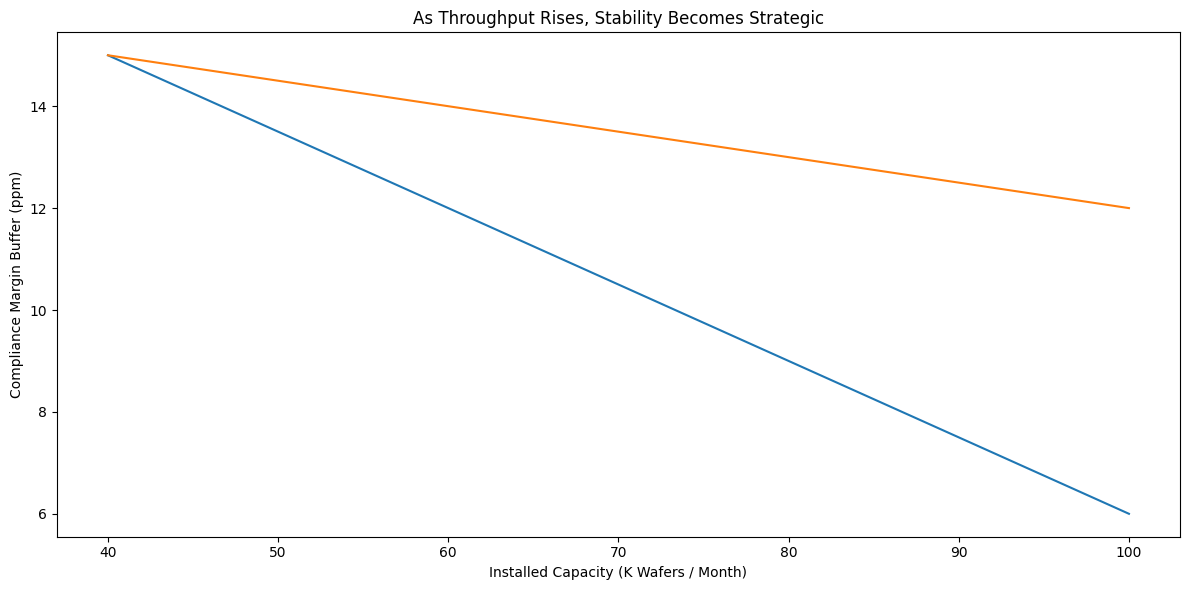
At the same time, installed capacity expands chemical throughput. Higher volumes increase cumulative loading. Even if systems remain compliant under steady-state conditions, variability during ramp periods or transient events becomes more consequential.
Small deviations that were once operationally manageable can become reportable events at higher scale.
Compliance margins compress as throughput rises.
Sludge, Classification, and Secondary Risk
Conventional treatment approaches that rely on precipitation generate secondary waste streams. As dissolved metal loading increases, sludge volume increases proportionally.
Higher sludge generation carries several implications:
- Increased hauling frequency
- Greater handling exposure
- Expanded documentation burden
- Elevated transportation risk
- Higher indirect carbon intensity
In some cases, waste classification thresholds become material considerations. What was once minor may cross regulatory boundaries at scale.
Environmental teams therefore manage not only discharge compliance, but also the lifecycle implications of treatment byproducts.
Operational Stability as Risk Reduction
As fabs grow, the value of predictable, stable treatment performance increases.
Systems that maintain selectivity across changing flow conditions reduce the likelihood of unexpected excursions. Real-time monitoring enhances early detection of influent shifts. Controlled separation approaches can reduce secondary waste generation compared to bulk precipitation strategies.
The objective is not simply to meet limits. It is to reduce volatility.
In large-scale operations, volatility carries disproportionate consequences. Stability becomes a form of risk management.
Reporting, Transparency, and Institutional Pressure
Beyond regulatory compliance, large semiconductor manufacturers face growing reporting expectations. Environmental disclosures, sustainability frameworks, and stakeholder scrutiny expand alongside production footprint.
Wastewater systems therefore influence more than permit adherence. They affect reported waste intensity, chemical usage metrics, hauling frequency, and greenhouse gas accounting.
Capacity growth increases the materiality of these factors.
The compliance paradox emerges from this intersection. Advanced facilities are technologically sophisticated, yet they operate in environments where tolerance for instability declines.
Growth magnifies consequences. Infrastructure decisions determine whether that magnification produces strain or resilience.
Stability as a Compliance Strategy
As semiconductor facilities scale, environmental exposure becomes less about isolated permit thresholds and more about operational predictability. Higher throughput compresses margins for error. Sludge volume increases under precipitation-based systems. Hauling frequency rises. Documentation burdens expand.
ElectraMet systems are designed to reduce volatility in high-capacity environments. By selectively separating dissolved metals electrochemically rather than generating bulk sludge, facilities can reduce secondary waste scaling as throughput increases. Controlled separation under variable influent conditions supports consistent discharge performance during ramp periods and product transitions. The objective is not simply compliance, but reduced instability within the compliance envelope.
In large-scale manufacturing environments, stability itself becomes a risk-management tool.
As fabs evaluate environmental strategy during expansion or retrofit planning, the relevant question is not only whether current systems meet limits today, but how resilient they will be under higher cumulative loading tomorrow.
If your facility is facing tighter discharge limits, rising sludge volumes, or increasing audit scrutiny, this is an appropriate moment to assess whether your treatment approach reduces volatility or merely manages it. Compliance margins narrow as capacity expands. Infrastructure choices determine how much operational room remains inside those margins.