
The Metal Behind the Digital Economy
Artificial intelligence infrastructure is expanding rapidly, but the materials required to support that expansion receive far less attention than the software and computing breakthroughs driving it.
Among those materials, copper plays a central role.
Copper is essential to electrical conductivity and appears throughout the infrastructure supporting digital systems. It is used in power transmission, data center construction, semiconductor manufacturing equipment, cooling systems, and the electrical networks that move energy between them.
As AI workloads scale and computing capacity expands, the amount of copper required to support that infrastructure increases as well.
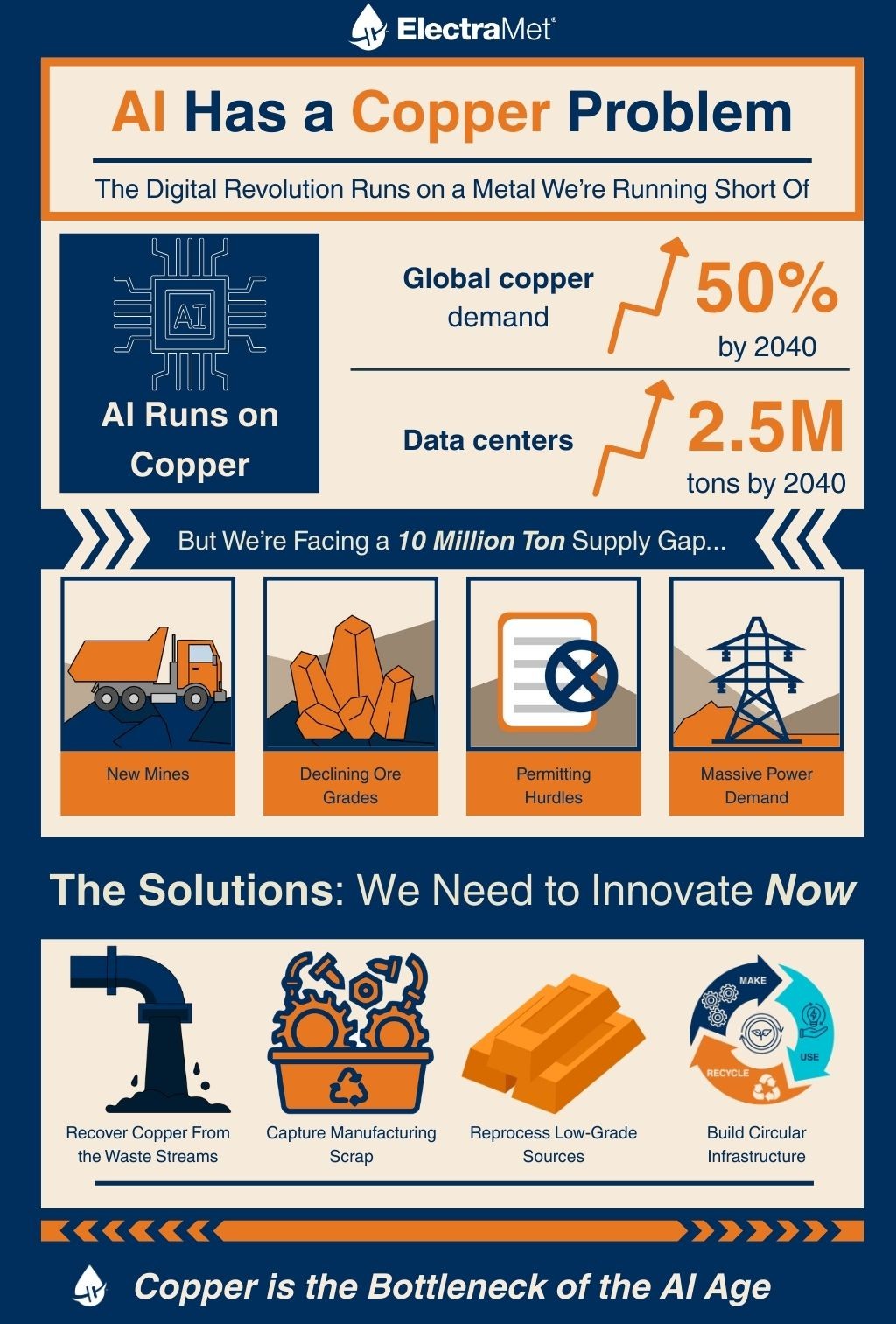
Several industry forecasts suggest global copper demand could rise by roughly 50 percent by 2040, driven by electrification, renewable energy development, grid expansion, and digital infrastructure. Data centers alone are expected to require millions of additional tons of copper over the coming decades.
Supply Expansion Is Not Simple
Meeting that level of demand is challenging.
Developing new copper mines requires long permitting timelines, significant capital investment, and access to large amounts of power infrastructure. At the same time, ore grades in many established mining regions have declined, meaning more material must be processed to produce the same amount of refined copper.
These structural challenges are contributing to a widening gap between projected copper demand and available supply.
For industries that rely heavily on copper, this gap is increasingly visible in discussions around resource stability, cost exposure, and long-term infrastructure planning.
Rethinking Industrial Copper Flows
As pressure on primary copper supply grows, attention is turning toward material flows that historically received less focus.
Industrial wastewater streams can contain dissolved copper from manufacturing processes. Production environments generate scrap material that may still contain recoverable metals. In some cases, lower-grade sources can also be reprocessed rather than discarded.
While none of these approaches replaces primary mining, they can help reduce waste, stabilize supply, and return valuable material back into industrial use.
How ElectraMet Can Help
ElectraMet develops electrochemical treatment systems designed to selectively remove and recover dissolved metals from industrial wastewater streams.
Rather than converting metals into sludge through chemical precipitation, electrochemical recovery can separate copper directly from solution under controlled conditions. This approach can reduce waste generation while returning recovered metal for reuse or recycling.
For industries such as semiconductor manufacturing, electronics production, and advanced materials processing, these systems can help facilities manage copper-containing wastewater while contributing to broader resource recovery efforts.