
Hydrogen peroxide (H2O2) is a versatile and extensively used chemical that plays a pivotal role across a range of industrial processes. Notably, it is heavily applied in the water treatment and electronics manufacturing sectors, where its oxidizing properties are harnessed for various cleaning tasks. Despite its usefulness, it is important to recognize the risks associated with it, and to handle concentrated H2O2 with extreme care.
What is Peroxide Used For
Industrial wastewater treatment allows us to preserve precious water resources and maintain environmental sustainability as we progress industrially and technologically. And we have an excellent, multipurpose tool to help us in this endeavor: H2O2. For over half a century, H2O2 has been used in water treatment due to its wide availability, affordability, and oxidative power. Used in both municipal wastewater treatment and industrial processing, it can serve as a bleach, act as an anti-microbial, or work to decompose organic residues. And when added to a corrosive mixture, it can substantially enhance the power of the etchant.
The applications of H2O2 reach beyond wastewater treatment. Microelectronics manufacturing uses large volumes of the reagent in cleaning and surface preparation tasks. Whether carrying away oxides and contaminants from printed circuit boards or stripping away residues from wafers in semiconductor fabrication, H2O2 cleans efficiently and effectively, lowering defect rates without compromising throughput. H2O2 appears in chemical-mechanical planarization (CMP), wafer cleaning, photoresist stripping, surface passivation, etching, descumming, surface finishing, and metal leaching, leaving behind only oxygen, water, and heat as it is consumed.
With the ever-increasing intricacy of chip designs and the shrinking of linewidth, more and more of these steps are needed, ensuring that H2O2 will play a key role in advancing the technology that defines the silicon age in which we live.
Managing Peroxide
Risks & Safety
While H2O2 is an impressively versatile chemical, the same qualities that make it so widely useful also make it potentially dangerous. Anyone choosing to use it in their processes must plan for the attendant safety hazards and environmental risks. Concentrated solutions of H2O2 are powerful oxidizers and will readily damage skin, eyes, and the respiratory tract. Engineering and administrative controls (such as ventilation systems and lock-out-tag-out procedures) are the primary protections for operators and the wider environment, while standard personal protective equipment (PPE) like gloves and eye protection further shield those who must interact with these solutions.
However, H2O2 is not only hazardous due to its corrosivity. It is an unstable compound, particularly at higher concentrations. Given enough time, any solution of H2O2 will decompose into water and oxygen gas, but in the presence of certain catalysts or when heated, this process accelerates. And as the decomposition itself generates heat, a runaway reaction is possible. This can lead to unexpected temperature spikes, which may damage polymer vessels or cause sealing surfaces to fail. A buildup of gas pressure due to oxygen generation may burst process lines or impede pump operation. For these reasons, any process using H2O2 also needs to carefully manage the heat generated by the reaction and maintain moderate facility temperatures.
Through responsible usage, storage, and safety practices, effective H2O2 risk management is possible. Designing equipment, processes, and procedures in a way that accounts for thermal and corrosive hazards provides protection for the operators and the environment, while also minimizing disruptions.
Regulations
As harmful as H2O2 can prove to humans, it is even more dangerous to aquatic life. Accidental discharges or improper H2O2 disposal can devastate aquatic ecosystems. Several practices can help to reduce the likelihood of this sort of damage. Diluting H2O2-containing streams with more water can bring the concentration of H2O2 down to safe levels for discharge. Physical barriers at a facility, such as berms and drain covers, can contain released H2O2 and prevent it from finding a larger body of water to contaminate. Investing in treatment equipment can neutralize H2O2 once it is no longer needed for a process. Taken together, these approaches can allow us to utilize a powerful reagent while mitigating its risks.
Responsible H2O2 use also involves understanding the relevant regulatory frameworks. Different authorities with different limits will be involved when discharging to the environment, versus reaching an acceptable threshold for drinking water. Federal, state, and local authorities may regulate H2O2 differently, and local environmental standards may be more stringent than federal ones. In some jurisdictions, acids mixed with oxidizing agents are regulated more strictly than the acids alone, which may incentivize on-site H2O2 abatement. It is also critical to stay up to date with any and all regulatory standards, so as not to fall out of compliance and risk penalties or shutdowns.
By remaining informed on emerging technologies and treatment methods, a firm can maintain a competitive edge. Proactively pursuing H2O2 abatement technology lets us decide how H2O2 will be managed and opens up new opportunities for dealing with the solution afterwards.
Treatment
In wastewater management, precise measurement of H2O2 concentration is key. These readings will dictate what treatment options are available to bring the H2O2 level down to meet either environmental regulations or process specifications. Widely available tools such as indicator strips, testing kits, and permanganate-based titration enable accurate and timely quantification. In some cases, in-line H2O2 detectors based the electrochemical destruction of the peroxide bond may be appropriate, though highly acidic streams may damage them.
Treatment and abatement methods vary. Off-site disposal may be an option, but large volumes of solution can make this untenable. Heating the unneeded solution until the residual H2O2 decomposes is another option, though the energy costs of doing so at scale can quickly render it unfeasible. A popular option is using some sort of catalyst to spontaneously trigger the decomposition reaction without adding heat.
Many firms use granular activated carbon (GAC) or the enzyme catalase for this purpose, though they have limitations of their own, such as slow kinetics or a limited operating range for pH. Proprietary solution providers like ElectraMet are another option. Ultimately, the unique operational needs of your facility will determine what the optimal H2O2 abatement approach looks like.
Pros and Cons of Hydrogen Peroxide Water Treatment
Pros:
- Powerful Oxidizing Agent: Hydrogen peroxide effectively breaks down complex contaminants such as metals, sulfides, and organic compounds, enhancing water quality and ensuring regulatory compliance.
- Eco-Friendly Byproducts: As it cleans, H2O2 decomposes into water and oxygen, leaving no harmful residues, making it a greener choice.
- Broad Application Versatility: Suitable for a range of process within a host of industries, from wastewater treatment to semiconductor wafer preparation, H2O2 offers flexibility across many applications.
- Reduces Chemical Dependency: H2O2 can often be substituted for other corrosives and oxidizers, simplifying supply chains and de-risking operations by removing more hazardous reagents from the process.
Cons:
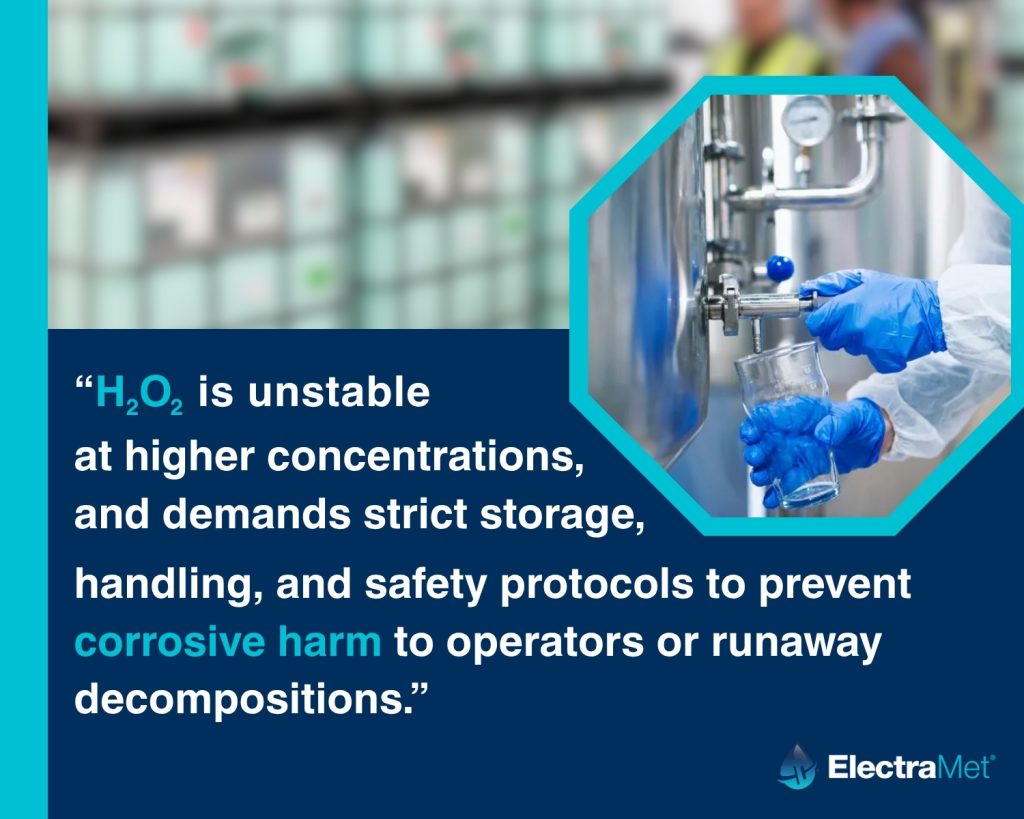
- Handling and Safety Concerns: H2O2 is unstable at higher concentrations, and demands strict storage, handling, and safety protocols to prevent corrosive harm to operators or runaway decompositions. Additionally, purchasing and storing large amounts of concentrated H2O2 may trigger regulatory oversight related to public safety or counter-terrorism provisions.
- Equipment Corrosion Risks: The oxygen produced by H2O2 is corrosive to many iron-based alloys, and the addition of H2O2 to ammonia or acid solutions can enhance their corrosivity. This can potentially increase maintenance costs, lower equipment lifetimes, and limit the selection of compatible materials.
- Cost at High Reagents: Using H2O2 in large volumes on a continual basis can be expensive, particularly in the context of wastewater treatment, where it may not be the best option for a highly budget-sensitive process.
- Selective Effectiveness: Hydrogen peroxide is not universally effective in removing all types of contaminants. Based on the process, supplementary treatment techniques may be needed to achieve process specifications.
ElectraMet’s Gamma System: Innovative Solutions
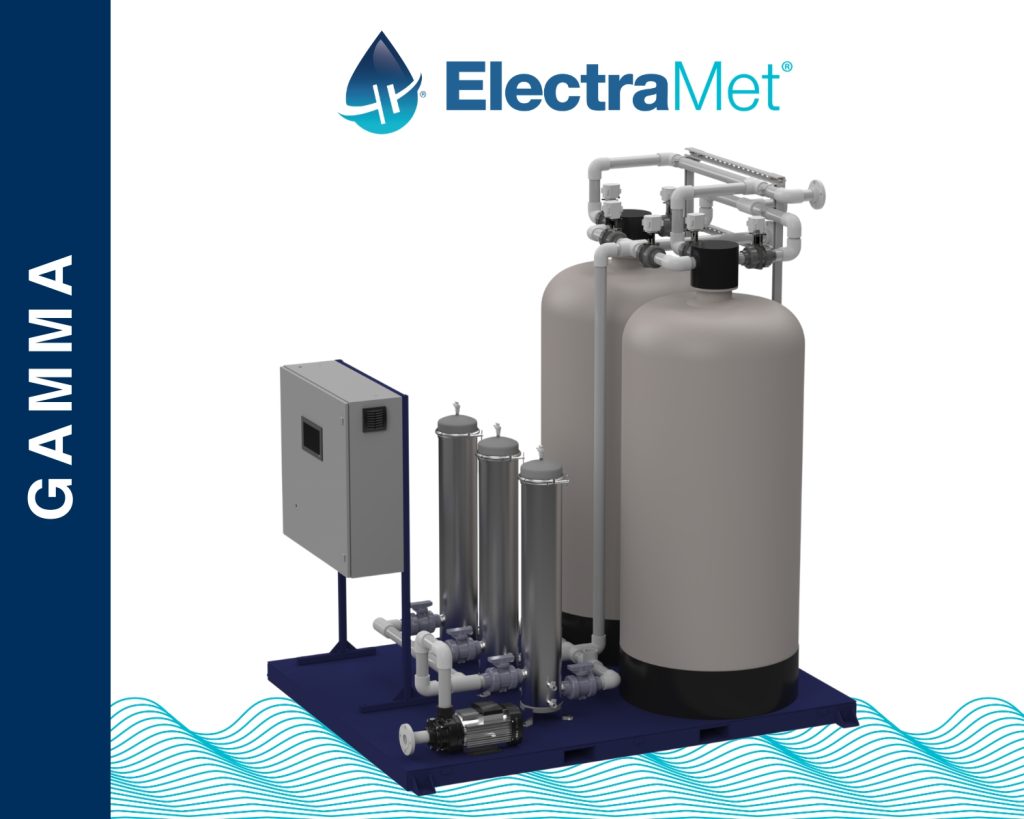
Enter ElectraMet’s Gamma System, our innovative solution designed to address the challenges of H2O2 destruction in water treatment. The Gamma System utilizes cutting-edge, chemical-addition-free technology to effect and scale H2O2 removal processes, ensuring regulatory compliance and minimizing environmental impact. With features such as stable performance in extremely corrosive process streams, real-time monitoring capabilities, and sub-ppm depth of removal, the Gamma System offers a reliable and sustainable approach to H2O2 abatement.
With a focus on knowledge and safety, together we can navigate the complex world of wastewater treatment and make informed decisions that balance compliance with operational outcomes.
Final Thoughts About H2O2
H2O2 is an immensely useful molecule. However, making use of something inherently unstable carries risks, and it is our responsibility to protect our employees, communities, and environments while producing the technological advances that move us all forwards. By taking ownership of your process chemistry and handling your waste streams with innovative solutions like ElectraMet, you have the power to optimize your treatment process to deliver maximum value with minimal impact.