
What Is F006 Waste?
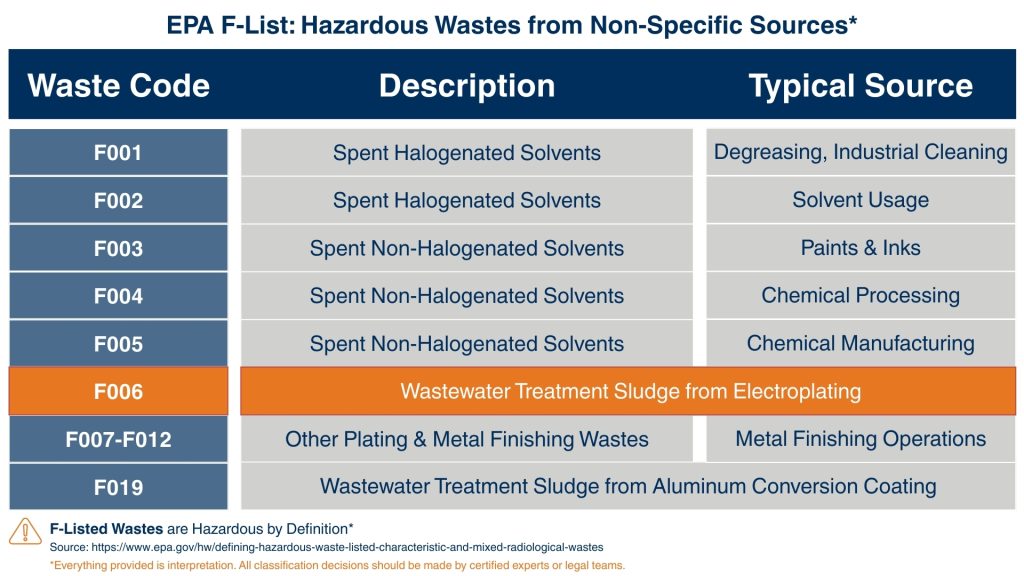
F006 is a hazardous waste classification under the Resource Conservation and Recovery Act (RCRA). It applies specifically to wastewater treatment sludges generated from electroplating and certain metal finishing operations.
This distinction is important. The raw wastewater itself is not automatically classified as F006. The designation applies after treatment, when dissolved metals are chemically converted into solids and removed from solution. The resulting sludge, depending on the source process, carries the F006 listing.
Processes commonly associated with F006 include electroplating, electroless plating, anodizing, chemical etching, and printed circuit board manufacturing. In many facilities, these operations are central to production. As a result, F006 is not a niche regulatory issue. It is embedded in day-to-day manufacturing.
Understanding where and how this waste is generated is the first step toward managing it effectively.
Why F006 Classification Matters
F006 waste is regulated at the federal level by the United States Environmental Protection Agency and often subject to additional state-level requirements. Facilities that generate F006 must comply with strict handling, storage, manifesting, and disposal standards.
Non-compliance carries obvious regulatory risk. But even when managed correctly, F006 introduces ongoing operational burdens. Hazardous waste accumulation areas must be maintained. Transportation and disposal contracts must be managed. Reporting requirements expand. Long-term liability remains tied to where the material ultimately ends up.
For many manufacturers, the cumulative cost of managing F006 sludge becomes a significant line item — one that scales directly with metal loading in the wastewater stream.
How F006 Waste Is Generated
Most F006 waste originates from conventional chemical precipitation systems.
In a traditional treatment train, dissolved metals are converted into insoluble hydroxides or other compounds through the addition of reagents. These solids are then settled, filtered, or pressed into sludge for disposal. The treated effluent may meet discharge limits, but the separated solids carry the hazardous waste designation.
This approach works from a compliance standpoint. It has been widely adopted for decades. But it fundamentally converts dissolved metal ions into regulated waste solids. The higher the metal concentration in the influent, the greater the sludge volume generated.
In effect, treatment performance and hazardous waste generation are tightly linked.
The Compliance Challenge for Modern Manufacturers
Today’s manufacturing environment has shifted. Discharge limits continue to tighten. Sustainability metrics are scrutinized more closely. Waste intensity and hauling frequency now influence internal reporting and external disclosures.
Facilities in semiconductor fabrication, advanced electronics, aerospace finishing, and specialty materials increasingly evaluate wastewater systems not just on whether they meet permit limits, but on how much waste they create in the process.
A system that achieves compliance while producing large volumes of F006 sludge may satisfy regulators, yet still strain budgets and environmental performance goals.
This is where treatment design becomes strategic rather than purely operational.
Rethinking the Treatment Model
Reducing F006 volumes does not mean avoiding compliance. It means examining how waste is generated in the first place.
Some facilities focus on upstream process optimization to limit metal carryover. Others reassess their reliance on precipitation chemistry, particularly in streams where dissolved metals remain valuable or where sludge volumes are high relative to flow.
When treatment systems selectively remove or directly recover dissolved metals instead of converting them into bulk hydroxide sludge, the overall hazardous waste profile can change. In certain applications, recovered metals may be handled as recyclable material rather than stabilized waste.
The shift is subtle but meaningful. Instead of asking how to manage more sludge efficiently, facilities begin asking how to generate less of it.
Compliance and Environmental Stewardship
Managing F006 waste effectively goes beyond regulatory compliance. It reflects a commitment to environmental stewardship and operational excellence. By understanding the nuances of F006 waste and implementing proactive waste management practices, businesses can protect the environment while improving operational efficiency.